
Supposedly the KIM-1 is 50 years old. Nobody seems to know the exact date it first shipped, but “January 1976” is the consensus so today seems as good a day as any.
What’s a KIM-1 I hear some of you ask? Well history is strange stuff, written by the victors, and retrospectively, but it has become celebrated as an important early microcomputer, second only to the Altair. Even more significant though: it was probably the first computer I used. I say probably because although I’m old, I was a child at the time and memory is hazy. Apparently my Dad invented the concept of keeping your kid busy by putting them in front of a computer.
The KIM-1 captures a step of many steps along the way to where we are today: The first couple of generations of microprocessors had already arrived when Chuck Peddle and colleagues decided to leave Motorola and found MOS Technology. One reason was a 1970’s form of RTO: Moto wanted them to move from Arizona to a new facility in Texas. The team decided it was better to start a new company and move to Pennsylvania. They designed the 6502 microprocessor, a (court adjudicated) rip off of the Motorola 6800. The 6502 went on to be the CPU in the very successful Apple II, VIC-20 and BBC micro.
Why that happened was mostly to do with (lesson here!?) how it was marketed. Peddle had been in the field talking to prospective customers while working at Motorola. Their prospective customers were companies making the existing products that could be re-designed to use it. This would have been primarily video terminals, high end calculators and low-end minicomputers, avionics and so on. Those existing products incorporated some sort of simple CPU built from TTL devices. So Motorola took the cost of those TTL devices, added some factors for size, power consumption, manufacturing cost and so on, and arrived at a selling price of $350. The innovation of Peddle and co was to invert the model and instead charge a price that was based on the cost to manufacture the chip. The 6502 had a reduced transistor count vs the 6800, and MOS had a better fabrication process, so that helped as well. The result was a “sticker price” of $20.
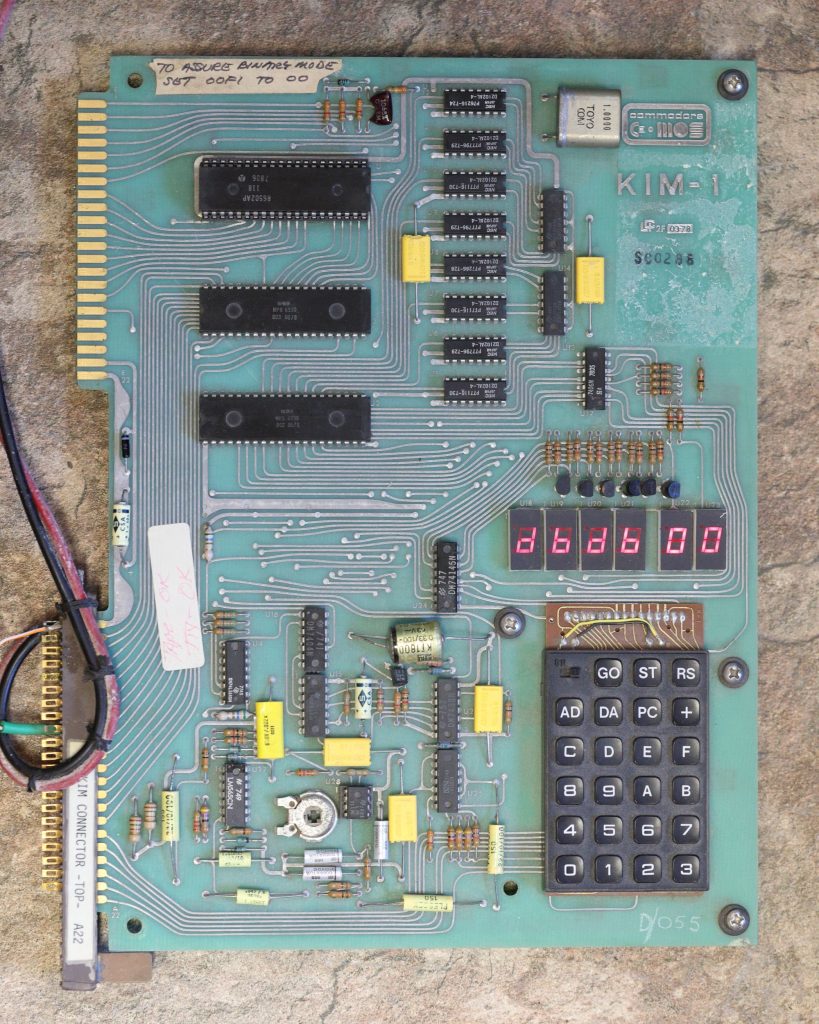
This much lower price ended up fostering the emergence of new kinds of products that didn’t previously exist such as Woz’s Apple 1, and eventually your iPhone. But in the meantime Peddle continued the guerilla marketing theme by designing the KIM-1. Microprocessor evaluation boards were not a new concept, but his design was both minimalist and made widely available at a reasonable price. It was a way to see a microprocessor doing something, right before your eyes, without needing to be a hardware engineer. Kind of like today’s Arduino and Raspberry Pi. Ultimately more than 7000 boards were sold, including my example from 1978, via Mr. eBay.
If you don’t have one in your closet needless to say there’s a nice browser-hosted emulator.
Recent Comments